Did you ever ask training partners for weight-cut advice, only to come out really confused? This happened to one of my clients recently. He went around asking people, including me, for advice on how to cut weight properly. Not only was some of the advice contradictory. Some of the advice was also not suited for the weigh-in format he was fighting in.
People mean well most of the time. But they lack the knowledge to actually give proper advice.
So he was obviously scratching his head until he decided to work with me. Let’s take a look at his weigh-in format, the advice he got, and how it would have hurt him.
Before, he used the Thai-style method to cut weight. So this was a breath of fresh air for him.
Weigh-in format
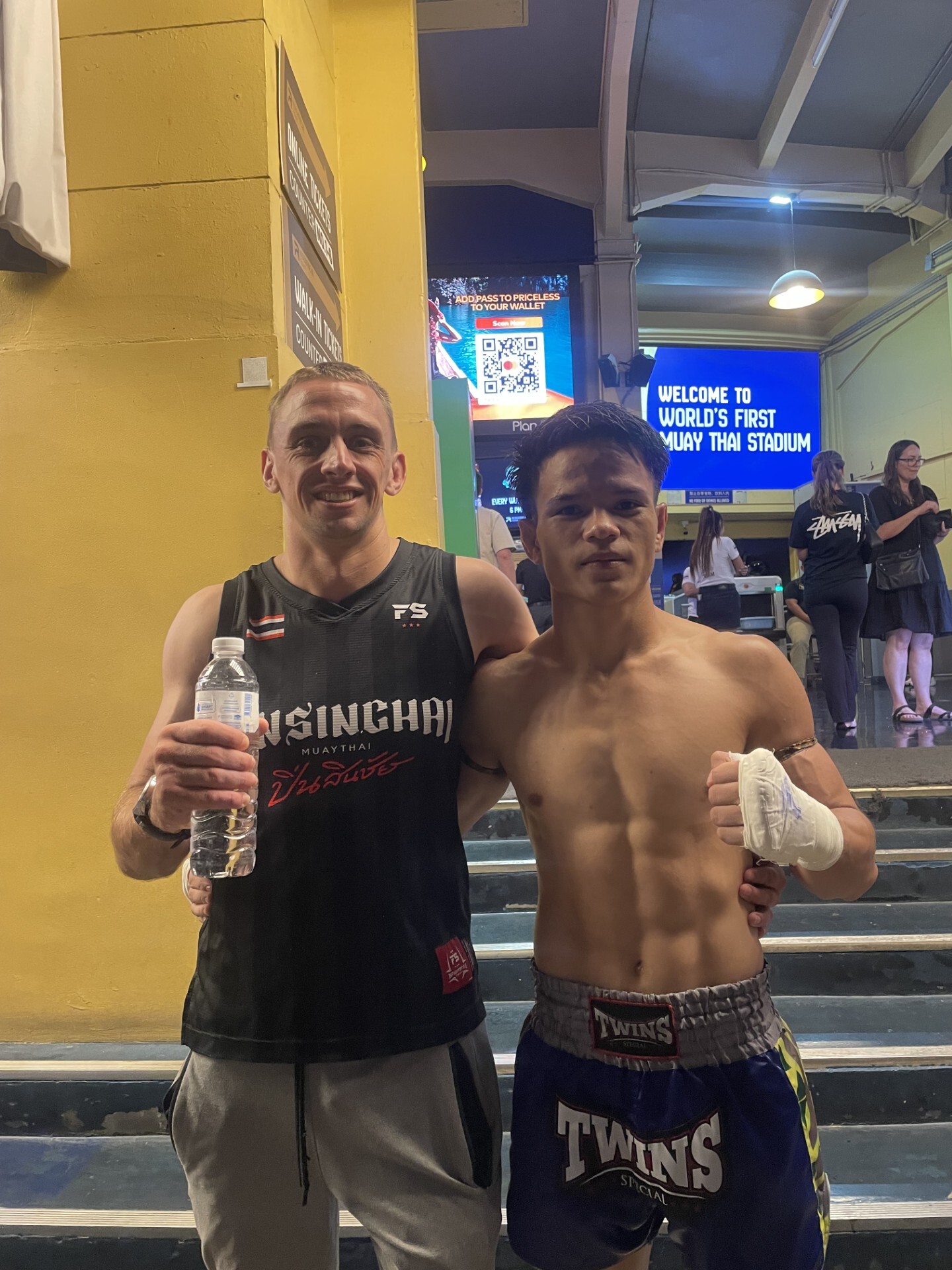
Somdet was fighting in Rajadamnern Stadium in Thailand. They check weight at 5:30 and start fighting around 18:00. So it’s a same-day weigh-in with a limited recovery window. He fought around 18:30.
He was 60 kg at the start of fight week and had to cut about 4.7 kg.
The advice he got was the cookie-cutter advice you’d expect, but there were some outstanding ones.
- Waterload with 7 liters for 5 days
- Start with 7 liters, then decrease daily
- Start the cut 5 days out
- Go really low-carb
- Increase sodium intake a lot on the first day of the cut
- Eat bland foods
- Some generic advice
Let’s now take a look at how none of this advice would have helped him and only made his life worse.
Waterloading.
There is a lot of bad information out there on water loading. People tend to overdo it when it comes to this. I once saw one influencer drink double the amount (11 liters) he needed according to the science. That is just stupid.
There has only been one study, so the science is easy to follow. 100 ml per kg of body weight is the maximum amount you need to drink. So for a 60 kg person, that is 6 liters maximum. BUT any increase in your normal intake would have an effect. You could drink half the amount and still lose weight.
Almost none of my clients drink the 100 ml per kg amount. They report feeling better and disliking it way less.
As for duration. 3 days of water loading with one day of tapering down the water is enough for this weigh-in format. But even for a day before weigh-in, 3 days is more than enough.
As for reducing the volume daily. I have seen this method before, but why would you start tapering down early and dehydrate yourself early? My recommendation is to stick to what works and follow the science.
What we did instead.
We took a look at his normal water intake and increased it based on the baseline number.
We also added zero-calorie drinks like Sprite Zero and Coke Zero.
In this way, the water load becomes a comfortable experience.
For Somdet, we had to make him waterload with 6 liters since his water intake was quite high already outside of fight week.
Going low-carb
Going low-carb works when you’re trying to cut weight. BUT there is a big caveat here.
It’s only applicable if you have at least 24 hours to recover those glycogen levels. He had about 12 hours.
If he had gone low-carb, he would have stepped into the ring diminished, risking slowing down in the later rounds due to him having to rely on willpower.
Yes, making weight is important, but being able to recover is just as important.
What we did instead.
Due to the limited recovery time, we kept carbs as part of his fight week diet. This made sure he could recover easily on fight day. Rather than depleting glycogen completely, we depleted it but just enough so we could top it up on fight day to make him last 5 rounds.
Somdet had over 50 grams of carbs daily and still lost weight easily.
Start the cut 5 days out
This isn’t necessarily bad advice, but it wasn’t necessary. People who cut 5 days for Thai-style weigh-ins mostly aren’t reacting as well to the weight-cut diet anymore, so an extra day gets added to make sure the final water cut isn’t too straining.
But with Somdet, I had data from his previous fight camp. The bout got cancelled last minute, sadly enough, but it gave me data to work with.
His weight dropped nicely, and he arrived at 56.3 kg the morning of the final cut. So he had 1 kg to lose in total.
He was underweight after the water cut and ate a bit to make sure he was perfectly on weight the next day.
Coming in underweight looks bad and might affect the gambling odds. So we adjusted for that.
After the weight cut, he ate 200 grams of chicken and a magnum.
The next day, he hit 122 lbs on the dot.
Increase sodium intake a lot on the first day of the cut
By retaining sodium in the body, the body will also retain water. Increasing sodium doesn’t make sense for 2 reasons.
- The Thai diet is already really high in sodium
- You set yourself one day behind in the cut.
What we did instead.
We followed the normal approach. We did the first day of the cut with a normal salt intake, and the following 3 days we lowered it to about 500 mg of sodium a day maximum.
Eat bland foods.
It’s self-explanatory. Most people take the joy out of everything, even their fight-week diet.
What we did instead.
Before fight week, I figured out which foods he liked and based the fight week diet on that.
And there was a mandatory magnum at the end of the day.
Cookie-cutter advice
People who have been long enough in the sport eventually see a pattern when they see people cut weight and rehydrate/refuel.
But seeing a pattern and actually being to make a personalized plan are 2 different things.
Sure, you know which foods to eat and in what order when refueling, but how much?
You’re just reaching in the dark if you can’t answer that.
And chances are you’ll mess up the rehydration and refuel because of it.
Somdet’s weight loss
As previously mentioned, he started the fight week diet at 60 kg. This is how this weight dropped.
Wednesday morning: 60 kg
Thursday morning: 58.5 kg
Friday morning: 57.1 kg
Saturday morning: 56.3 kg
All without unnecessary suffering. His final cut was a walk in the park.
In Conclusion
So what did we learn from this post?
Somdet made weight comfortably, recovered properly, and fought at his best.
That’s the difference between following random advice and following a plan built around your specific weigh-in format.
If you need help with your next fight camp, you can work with me here.
Alex
